
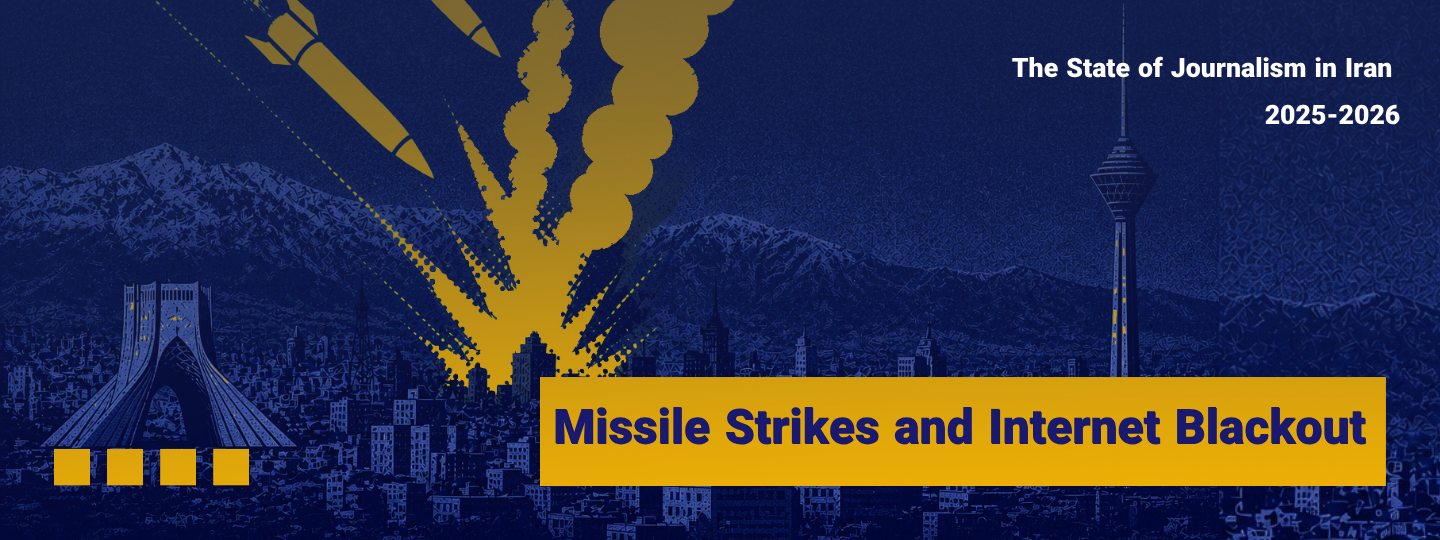
Over the course of the Iranian year 1404 (March 2025 – March 2026), Iran’s media landscape underwent a decisive transformation, one that redefines the role of journalism itself. What was once primarily a space for reporting events has increasingly become a controlled environment where narratives are shaped, constrained, and, at times, engineered.
This report, based on the analysis of more than 300 documented incidents, finds that media control in Iran is no longer exercised through isolated interventions. Instead, it has evolved into a coordinated system, where legal enforcement, security pressure, economic constraints, and digital infrastructure operate together.
At the center of this transformation is a structural shift: control is no longer limited to content, it now extends to access, behavior, and participation in the information space.
Three forces define this new reality:
The securitization of journalism
The normalization of adaptive censorship
The expansion of digital and infrastructural control
How This Analysis Was Built
The findings draw on a structured dataset compiled by Midpoint School of Journalism, covering more than 300 media-related incidents between March 2025 and March 2026. Each case was treated as a discrete unit, linking actors, actions, and outcomes.
The dataset was then cleaned, categorized, and mapped across three levels of actors: individuals, institutions, and international forces. While the data provides a robust picture of trends, it likely underrepresents reality. In Iran’s restricted information environment, many incidents remain undocumented or inaccessible.
How This Analysis Was Built
The findings draw on a structured dataset compiled by Midpoint School of Journalism, covering more than 300 media-related incidents between March 2025 and March 2026. Each case was treated as a discrete unit, linking actors, actions, and outcomes.
The dataset was then cleaned, categorized, and mapped across three levels of actors: individuals, institutions, and international forces. While the data provides a robust picture of trends, it likely underrepresents reality. In Iran’s restricted information environment, many incidents remain undocumented or inaccessible.
Journalism as a Security Issue
Censorship in Iran no longer appears as a series of visible crackdowns. Instead, it functions as a permanent, adaptive system, one that fluctuates in intensity but never fully recedes.
Periods of political or military tension trigger spikes: warnings are issued, platforms restricted, and connectivity disrupted. But even outside these moments, pressure remains constant.
The goal is no longer simply to remove unwanted content. It is to reshape the cost of producing it.
Legal threats, administrative sanctions, and professional risks create an environment where self-censorship becomes a rational response. Journalists and media outlets increasingly operate within invisible boundaries, limits that are rarely stated outright, but clearly understood.
The result is a system of soft but pervasive control, where compliance is often achieved without direct intervention.
When War Targets the Media
Another defining shift of the past year is the changing role of media in conflict.
Traditionally positioned as observers, media institutions in Iran have increasingly become targets and instruments within the conflict itself.
Incidents involving military strikes, damaged infrastructure, and casualties among journalists were relatively limited in number, but high in significance. Reports indicate that organizations such as IRIB, Mehr News Agency, and other outlets were directly affected.
This marks a critical turning point:
Media is no longer external to war, it is embedded within it.
In this environment, controlling narratives becomes as strategically important as controlling territory.
From Blackouts to Precision Control
Perhaps the most consequential transformation is happening in the digital sphere.
While large-scale internet shutdowns and platform filtering remain in use, a more targeted approach is emerging, one that operates at the level of individuals rather than populations.
Documented cases point to:
– Sudden SIM card deactivations
-Selective disconnection from communication networks
-Loss of access to financial and administrative systems
In some instances, access was reportedly restored only after individuals complied with specific conditions, such as removing content. This represents a shift toward “smart disruption”:
-Less visible than mass shutdowns
-More precise in targeting
-Politically less costly
Control is no longer about limiting information flows alone. It is increasingly about regulating who is allowed to participate in the digital and social ecosystem at all.
A System, Not Separate Tools
What emerges from these patterns is not a collection of isolated tactics, but a coordinated architecture of control. External conflicts raise the stakes around information.
Judicial mechanisms enforce compliance.Censorship shapes behavior. Digital infrastructure determines access. Economic pressure weakens resistance. Each layer reinforces the others. Together, they form a system that is both flexible and resilient, capable of adapting to changing conditions while maintaining overall control.
The Actors Behind the System
This ecosystem is sustained by a network of actors operating at different levels.
Judicial and security institutions sit at the center, defining the legal and operational limits of media activity. Journalists and media organizations, meanwhile, function under sustained pressure, yet continue to produce alternative narratives.
Professional associations and international organizations provide advocacy and visibility, but their ability to influence outcomes remains limited.
In the background, geopolitical tensions, particularly involving Israel and the United States, act as catalysts, intensifying internal control dynamics without directly managing them.
Conclusion: A New Model of Information Control
The developments of 1404 do not point to temporary restrictions or cyclical crackdowns. They signal the emergence of a new model of information governance in Iran.
This model is defined by integration:
Legal, security, economic, and technological tools no longer operate separately, they function as a unified system.
It is also defined by expansion:
Control now extends beyond content to include access, identity, and participation.
In this environment, power in the media space is no longer determined solely by who can produce or distribute information. It lies increasingly with those who can control visibility, access, and the conditions of engagement.
Yet the system is not static. As mechanisms of control evolve, so do strategies of adaptation, by journalists, audiences, and alternative platforms.
The future of journalism in Iran will not be shaped by control alone, but by the ongoing tension between restriction and resistance.
Final Word
The developments documented in 1404 do not represent a series of isolated incidents. They reflect the consolidation of a new information governance model in Iran — one defined by the integration of legal, security, economic, and technological tools; the shift from reactive to systemic control; and the expansion of control from content to access and identity.
Power in the media sphere is no longer determined solely by the ability to produce or distribute information, but by the ability to control access, visibility, and participation. While alternative narratives continue to exist, their reach is constrained by a profound imbalance of enforcement power.
Yet this system is not static. As control mechanisms evolve, so do strategies of adaptation, resistance, and alternative communication. The future of Iran’s media landscape will depend not only on the intensity of control — but on the dynamic interaction between control and adaptation.